Bus Stop or Demand-Responsive Ride: Two Ways to Reach a Service
Compare a fixed-route bus with a demand-responsive ride to choose a journey that fits your appointment, pick-up point and return plans.
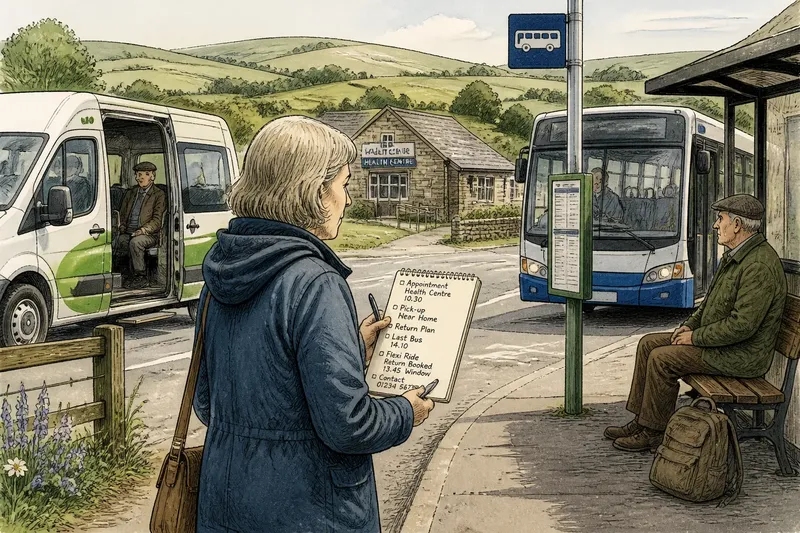
The common mistake when choosing rural transport is to compare only the advertised departure time. A bus stop or demand-responsive ride can both get you to a service, but one follows a set path while the other is shaped around booked requests. Choose by looking at the whole journey: where it starts, how much timing certainty you need and what happens on the way back.
What does each service actually offer?
A fixed-route bus runs along a published route and serves designated stops. You plan around its timetable and walk, cycle or arrange a lift to the stop if it is not close to home. The route may connect several villages with a surgery, shop, library, market town or transport interchange.
A demand-responsive service, sometimes called a dial-a-ride or flexible bus, accepts bookings and plans journeys around them. Depending on the scheme, it may collect passengers at an agreed point, serve a defined area or connect people to a hub where they can continue by bus or another service. It is not necessarily a taxi: the vehicle may carry other passengers and take a route that changes from one trip to another.
Names and arrangements vary. Check the operator’s service description, booking terms and any local transport information before relying on a particular pick-up method or connection.
Where does predictability matter most?
A fixed route gives you a visible structure. You can identify the stop, check the timetable and see which places the service reaches. That is useful when you value a repeatable journey or want to make an onward plan around a published arrival time.
The trade-off is that the bus does not come to your door just because that would shorten the journey. A distant stop, an inconvenient route through several settlements or a long wait between services can make the trip awkward. A timetable can also leave little room for a delayed appointment or a slow walk from a building to the stop.
With a request-based ride, the pick-up may be closer and the route may suit a destination that a conventional bus does not serve directly. But the journey’s shape is less fixed. Other bookings can affect the route or timing, and a seat may need to be reserved in advance. Treat the confirmed booking information, rather than an assumption about a direct trip, as the basis for your plan.
How should you map the journey?
Start with the service you need to reach. Write down its location, the time you must arrive, how long you expect to be there and the place you need to return to. Then look at the outward and return journeys separately. Rural services may suit one direction better than the other.
- Find the real starting point. Check whether the bus stop is walkable from home and whether the request-based service serves your address or a nearby pick-up point.
- Check the arrival window. A fixed timetable gives a listed arrival; a flexible service may provide a booking time or window. Allow for the time needed to get from the drop-off point to the building.
- Trace the route onward. If the bus or flexible service ends at a hub, check the next leg and how much time separates the connections.
- Plan the return before leaving. Note the last suitable bus or the process for arranging a return booking. Do not assume a ride can be requested spontaneously.
- Check access and payment details. Confirm how to pay, whether the vehicle and pick-up arrangements suit your mobility needs, and how to ask for assistance.
- Keep a fallback in view. Identify whom to contact if a booking changes or a connection is missed, and whether another practical option exists.
Say you have a morning appointment at a health centre in a nearby town. The bus reaches the town at a listed time, but the stop is a long walk from the centre. A request-based ride may offer a closer drop-off, yet its booking window could make a tight appointment risky. If you reserve that ride and allow time for the appointment to run late before arranging the return, you can compare the actual door-to-door plans rather than choosing by the outward departure alone.
When does a bus stop or demand-responsive ride fit better?
Lean towards the fixed-route bus when a stop is accessible, its timetable fits the appointment and you benefit from a clear route or regular connection. It can also be easier to use for an unplanned return if buses run at suitable intervals and you can wait safely.
Consider the request-based option when the designated stop is impractical, the destination sits away from the route or the scheme offers a useful link to a service hub. It may also help when a booking system can accommodate the journey’s access needs. Flexibility in route does not automatically mean flexibility in booking time, so confirm what the operator can offer.
Neither model is automatically more reliable for every trip. The relevant question is which uncertainty you can manage: walking to a fixed stop and following the timetable, or booking ahead and allowing for a shared, variable route.
What should you ask before booking or setting out?
How far ahead should I book a demand-responsive ride?
Check the operator’s booking window, available days and process for changing or cancelling a trip. If the journey is tied to an appointment, book as early as the service allows and confirm the pick-up details.
Will a demand-responsive ride take me directly to the destination?
Not always. Ask whether it serves the address, uses a nearby stop or connects passengers at a hub, and whether other bookings can affect the route.
Can I use a fixed-route bus without a paper timetable?
Often, timetable information is available through an operator’s website, a printed notice at a stop or a local transport office. Save the relevant journey details before setting out if mobile reception may be limited.
What if my appointment overruns?
Find out whether a return ride can be amended and what happens if you miss a booked collection. For a bus journey, identify a later departure if one exists; if neither option leaves room for delay, ask the service provider about a suitable appointment time.
How can you make the choice repeatable?
After checking the details, keep a small journey note on paper or in your phone. Record the useful stop or pick-up point, the operator’s contact method, the booking reference if relevant, and the return plan. This is not a substitute for checking current service information; it saves you from rebuilding the whole plan each time.
For a new route, try to settle practical questions before the day: where to wait, what name or address to give when booking, and where you will be dropped off. If someone is travelling with you, agree who will check updates and who will contact the operator if plans change.
For the next trip, compare the bus stop or demand-responsive ride using the same essentials: access to the pick-up, arrival timing, onward connection and return options. The best fit is the service whose journey you can follow and adapt without leaving a crucial part of the plan to guesswork.