The Parish Noticeboard Before the Online Post
The parish noticeboard made local information visible in passing. Learn what belonged there, where placement mattered and when a notice needed another route.
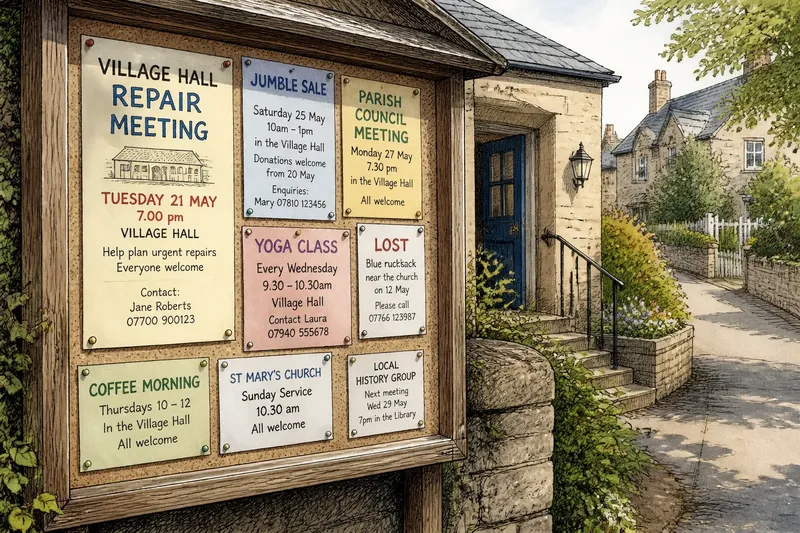
The common mistake with a parish noticeboard is to treat it as a spare wall for anything someone wants others to know. That leaves urgent or specialised information beside old, unrelated paper, where people may miss it. The parish noticeboard worked best as a local information tool shaped by its setting: who passed, what they could stop to read and what the surface could hold.
Before an online post, a notice had to meet people where their ordinary journeys already took them. A board by a church gate, village hall or shop entrance could make an event visible without requiring a device, account or deliberate search. But a board could not reach everyone, and its location affected which messages received attention. The right choice depended on the notice, its audience and the place available.
What kind of notice belongs on a parish board?
Use the board for information that benefits from being encountered in passing and can be understood quickly. A jumble sale, parish meeting, hall opening, lost item or local group gathering can fit well. These notices usually have a clear subject, a place to go and a way to find out more.
Choose another route, or add one, when the information is time-sensitive, private, complicated or meant for a particular household. A board cannot alert someone who does not pass it, and a brief paper notice is a poor substitute for a direct conversation about a personal matter. A public emergency message also needs an appropriate official channel; do not assume a noticeboard will be seen promptly.
- Community event: Put up a concise notice with the organiser, venue and contact route.
- Recurring local service: Use a board that people visit as part of their usual routine, and make the schedule easy to scan.
- Personal or confidential issue: Contact the person privately rather than pinning details in public.
- Urgent change: Use a direct or official communication channel as well as any noticeboard.
- Long explanation: Post a short summary and a suitable place to get the full information, if one is available.
Say you are organising a village hall repair meeting and want nearby residents to attend. A notice by the hall entrance can give the meeting purpose, time, venue and contact name; someone who uses the hall may notice it on the way in. If the meeting is moved, the organiser should update that notice and contact people who have already arranged to attend rather than relying on the board alone.
Where should the board sit?
Start with the likely readers, not with the most prominent wall. A board outside a place people visit for another reason can catch attention naturally. A board tucked inside a building may be useful to regular visitors but invisible to people who do not enter. A sheltered spot can protect paper, while a public-facing position can make reading easier without requiring access during opening hours.
Each location has a different audience. A church noticeboard may serve people connected with services and events. A village hall board may reach clubs, organisers and visitors to local activities. A shop entrance can catch people running ordinary errands, but only if the owner or manager permits notices and the display does not obstruct the entrance. There is no single best location for every community.
Consider whether a reader can stop safely and comfortably. A board beside a narrow path or busy doorway may be visible but awkward to approach. Poor lighting, glare, rain exposure and a high or cluttered display can make words difficult to read. The setting is part of the message: if people cannot pause or see the paper clearly, visibility alone is not enough.
How did the setting shape what people noticed?
A physical board offered no automatic sorting by topic or date. Position, size, contrast and neighbouring notices did that work. A large sheet near eye level could dominate a smaller card, even if the smaller notice mattered more to a particular reader. A crowded board asked people to decide quickly whether to keep looking.
Make the first glance useful. Put the event or service name in a clear heading, then give the essential details in plain language. Keep the print legible from a comfortable standing distance and leave space around the notice. Use a small amount of colour for distinction rather than relying on subtle shades that may disappear in dim light or under a plastic cover.
The board also made some information public by default. Anyone with access could read what was pinned there, and a notice might remain visible after its purpose had passed. Avoid personal addresses, private circumstances or details that do not need to be shared. Ask before posting material on behalf of a club, charity or public body, and make the organiser identifiable so readers know where questions belong.
Should a notice go on paper, online or both?
Choose paper when the intended readers are likely to pass a particular place, when the notice is brief, or when not everyone uses the same online spaces. Choose an online post when people need to share, update or consult details remotely. Use both when the audience is mixed and the notice matters enough to warrant more than one route.
Neither format reaches everyone. A board depends on location and footfall; an online post depends on access, visibility within a platform and a person’s habit of checking it. A noticeboard can offer a steady, local point of reference, but it does not provide a reliable record of who has seen the message. An online post can be changed quickly, but readers may encounter an old copy elsewhere.
If a notice appears in both places, keep the core details consistent. Name one contact or source for changes. Remove or mark the paper notice when it is out of date, and update the online version rather than leaving conflicting information in circulation. Follow the site’s posting rules and any relevant local requirements.
Which noticeboard choice fits your situation?
What if the audience already visits one shared place?
Use the board at that place if people can access it and pause to read. A hall notice suits a hall event; a board near a regular community service may suit information for its visitors.
What if readers are spread across the parish?
A single board is unlikely to serve everyone equally. Choose a place people already travel to, then add another communication route if the information needs broader reach.
What if the message changes often?
Use a channel that can be updated promptly, with a paper notice only if it adds useful local visibility. Make clear where the current version can be checked so an old sheet does not mislead.
What if the information is sensitive or urgent?
Do not rely on a public board. Contact the people concerned through an appropriate direct or official route, and use a qualified organisation where the matter calls for specialist advice.
How can a parish keep the board useful?
Agree who can post, who checks the display and how organisers can request space. A named caretaker might be a parish clerk, hall manager, shopkeeper or volunteer, depending on who controls the site. Keep the arrangement simple enough that a community group can use it without guessing whom to ask.
Review the board as a reader would. Can someone tell which notices are current? Are essential details visible without lifting another sheet? Is the route to ask a question clear? Remove expired material with the organiser’s knowledge where practical, and leave room for new notices rather than letting the display become a paper archive.
The parish noticeboard remains useful when it is treated as a place-based service, not a universal notice delivery system. Match the message to the people likely to pass, make the paper easy to read, and choose another route where privacy, urgency or distance demands it. That is the practical value of the parish noticeboard: it puts local information into a shared physical setting, where the setting itself determines who can notice it.