The Open Meeting Myth: Attendance Is Not the Whole Process
Following a rural public decision means checking the agenda, record and later action—not relying on one meeting to reveal the whole process.
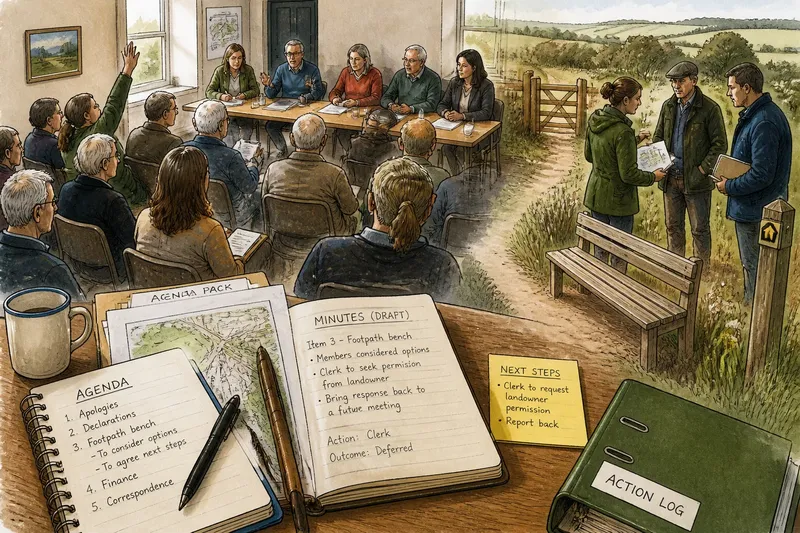
The common mistake is to treat attendance at a public meeting as the whole story. For a rural decision, that can leave you with a vivid impression of the discussion but no clear account of what was decided, what remains open or who is expected to act. Following a public decision means tracing its discussion, records and later action, whether or not you were in the room.
This matters in a parish council, village hall committee or local service forum, where an agenda item may begin as a question, return later for a decision and then pass to someone else for delivery. Use these seven checks to follow the process without mistaking one evening’s conversation for its outcome.
1. What is the meeting being asked to do?
Start with the agenda, not the assumption that every item is up for a vote. Look for the wording beside the subject. “To receive an update” points to a report. “To consider options” invites discussion. “To agree” or “to approve” signals that members may be asked to make a decision.
Those phrases are not interchangeable. A discussion can shape a proposal without authorising it. A committee might hear residents’ concerns about a footpath, ask for more information and defer a decision until a later meeting. If you leave after the discussion believing that the route has been changed, you may have misunderstood what the body actually agreed.
Check which body is meeting, too. A parish council, a district council committee and a community hall trust can each discuss a local issue, but they do not necessarily have the same responsibility or authority. The agenda usually names the meeting and its items. If an item refers to a report or earlier decision, open that document as well; the short agenda line may not explain the choice on the table.
2. Which records help you follow the decision?
A meeting has several records, and each answers a different question. The agenda tells you what members were scheduled to consider. Supporting papers may show the options, costs, correspondence or advice they had in front of them. The minutes record the formal proceedings and decisions. Later reports or action updates can show what happened after the meeting.
Do not expect the minutes to reproduce every comment. Their purpose is generally to record the meeting’s business, not provide a verbatim account. They may show that members considered a proposal, agreed an action or deferred a matter, while leaving out the full exchange that led there. If a particular comment matters, check whether a recording, transcript or other formal record is available rather than treating a neighbour’s recollection as the official record.
Records may not appear together or at the same time. A draft minute can differ from the version later approved, and an attachment may be filed separately from the agenda. Look for the meeting date, the item heading and the document status. If the record is hard to locate, ask the clerk or the organisation’s contact for the relevant agenda pack and approved minutes. A precise request is easier to answer than a general question about “what happened”.
3. What happened in the room, and what did not?
Attendance can help you hear the discussion and understand how members weigh competing concerns. It is also a chance to speak if the meeting allows public comment and you follow its arrangements. But being present does not automatically make you a participant in every part of the meeting, and speaking does not itself make a proposal an agreed decision.
There may be a designated public-participation slot, a time limit or a rule that questions must be submitted in advance. Some business may be handled in a closed session where permitted. Check the meeting’s published arrangements before attending, especially if you plan to raise a detailed point. Keep your contribution focused on the decision: name the item, state the concern and say what information or action you are asking members to consider.
If you cannot attend, you can still follow the public record. Read the papers beforehand, send a concise question through the stated channel and check the minutes afterwards. That will not replicate the experience of being there, but it can help you distinguish the formal decision from a comment, suggestion or promise to investigate.
4. How can you tell discussion from a decision?
Listen for the exact motion or resolution, not just the strongest statement in the room. A member may propose a course of action, another may suggest a change, and the chair may then confirm the wording put to a vote. The recorded result matters: a proposal that was discussed but not moved is different from one that was formally agreed.
When reading minutes, look for verbs such as “resolved”, “agreed”, “noted”, “received” and “deferred”. “Noted” usually indicates that information was received, not that the body approved a related action. “Deferred” means the matter is postponed, though the record may also identify what information is needed before it returns. Read the full sentence and any conditions; a resolution can authorise one limited action without approving the wider proposal.
Say you are following a hypothetical proposal to place a bench beside a rural footpath. At one meeting, members discuss access and ask the clerk to check permission from the landowner. The expected observable result is a record showing that permission was requested, not that the bench was approved or installed. If a later meeting considers the reply and resolves to proceed, that later resolution marks a different stage.
5. What should you check after the meeting?
Look for the next public step. The minutes may name a person or committee to make enquiries, request a revised quotation, consult another authority or bring a report back. A decision can be complete in principle while still depending on a practical condition. The record should help you identify what is meant to happen next, even if it does not supply a delivery date.
Then check the next agenda and papers. If the matter returns, compare the new proposal with the earlier resolution: has the requested information arrived, has the wording changed, and is the body now being asked to decide or merely receive an update? For a parish issue involving a county or district service, look for the named outside body and its response rather than assuming the parish meeting controls the outcome.
Follow up with a focused question if the trail stops. Ask which action was agreed, whether it has been completed, and where the next update will be recorded. Avoid treating silence as proof that nothing is happening; equally, do not treat an informal assurance as completion. Seek a date or document to check again only if the organisation can provide one.
Which questions help you read a public decision?
Are public meetings open to everyone?
Many local public meetings are open to observers, but access arrangements and any exceptions depend on the body and the business. Check the published notice for the venue, remote-access details and public-participation rules.
Do minutes have to include every speaker’s words?
Minutes commonly record decisions and the main business rather than provide a verbatim transcript. If exact wording matters, ask whether a recording or another formal record exists.
Can a resident make a decision at a parish council meeting?
Residents may be able to speak during a public-participation period, but formal decisions are made by the members entitled to vote. Check the meeting rules to see how comments are received and whether a written submission is appropriate.
What if the minutes do not explain what happened next?
Ask the clerk or relevant organisation which action was recorded and whether the issue is due to return to a meeting. Request the related paper or later update so you can follow the decision through its next stage.
How do you keep a clear record of the process?
Use a simple note with four fields: meeting date, agenda item, recorded decision and next action. Add the document name or link beside each entry. This keeps a proposal, resolution and follow-up distinct without requiring a long account of every exchange.
For a recurring issue, keep the entries in date order. If the wording changes, note the change rather than overwriting the earlier entry. A new motion may narrow the original proposal, or a later report may show that another authority must act. Preserve those distinctions: they are often the reason a decision appears to move slowly.
The open-meeting myth fades once you treat attendance as one way to hear discussion, not as a substitute for the record. To follow a public decision, match the agenda to the papers, identify the formal resolution, then check the named action in later minutes or updates. That short trail gives you a more dependable account than a single evening’s impression—and tells you exactly what remains to be asked.